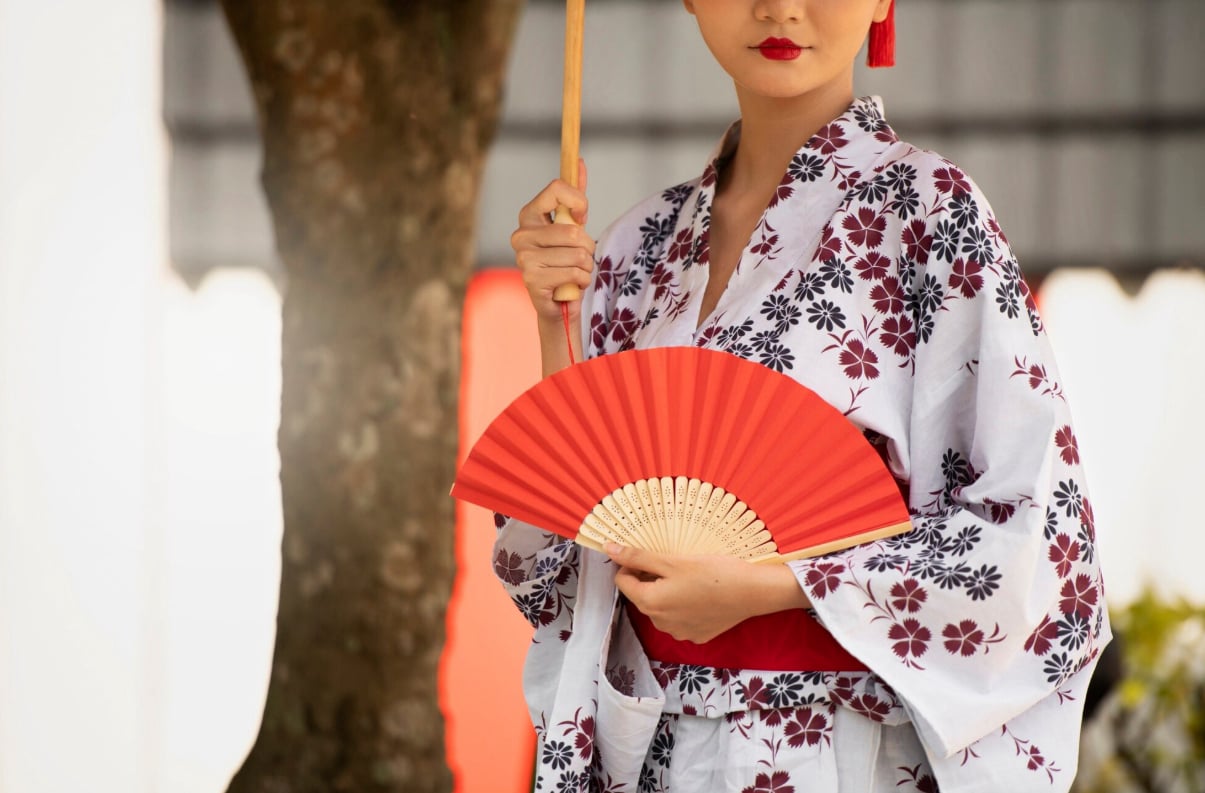
Kimono: Woven Poetry
The kimono is far more than a mere garment — it is a living language of symbols, seasons, and unspoken social nuances. Far from a simple robe, its straight-line construction and intricate layering transform the body into a canvas. Every element, from the overlap of the collar (which always goes left over right, except for the deceased) to the length of the sleeves, carries a specific meaning. Wearing a kimono properly is an act of deep cultural literacy, a silent poem written in fabric and fold.
The visual design of the kimono often borrows directly from the natural world and the principles of ikebana. A branch of wisteria crossing the hem echoes an asymmetrical flower arrangement, while scattered autumn leaves mirror the concept of ma (negative space). Patterns change strictly with the months: plum blossoms for the hope of early spring (January/February), irises for May's boy's festival, and maple leaves for the quiet of autumn. Each design is not decoration but a calendar and a meditation on transience.
Putting on a kimono requires learning a choreography that resembles the tea ceremony. One must adjust the ohashori (the hip-length tuck) for balance, tie multiple strings (himo) to secure the layers, and wrestle the obi (sash) into an elaborate knot — all often without the aid of a full-length mirror. The process demands patience, flexibility, and a deliberate sequence of actions. Just as the tea master's movements are precise but seem effortless, a seasoned kimono-wearer develops a flow that transforms dressing from a struggle into a daily ritual.
The intersection of kimono and calligraphy appears in the most formal of garments. On kurotomesode (formal black kimono for married women) or haori jackets, one might find family crests rendered in precise ink strokes or even poetic inscriptions brushed by famous calligraphers. The aesthetic of the kimono aligns with the aesthetic of the brush: both value the strength of a single line, the beauty of an asymmetrical composition, and the power of restraint over clutter. An empty space on a kimono sleeve speaks as loudly as an unpainted area in a sumi-e painting.
Japanese aesthetic concepts find perfect physical expression in kimono culture. Miyabi (courtly elegance) is seen in the multi-layered kasane colors of the Heian period, where sleeves peeking out reveal hidden hues. Iki (refined chic, born of the Edo merchant class) appears in subdued greys, browns, and blues with understated patterns. The tea ceremony's emphasis on cleanliness and humility aligns perfectly with the meticulous care kimono require — brushing off dust, airing out the folds, and storing them wrapped in paper to preserve the fabric from light and insects.
By studying kimono alongside calligraphy, ikebana, and the tea ceremony, one begins to see a profound cultural coherence. The way a kimono's collar is pulled back to reveal the nape of the neck (considered an erogenous zone in traditional Japan) parallels the way an ikebana branch is angled to show "the face" of the flower. The careful tying of the obi knot mirrors the focused breath before a brushstroke. No financial outcome is promised — only a richer understanding of how beauty is worn, lived, and passed down through threads. In the end, the kimono is not just woven poetry; it is the very skin of Japanese tradition.